
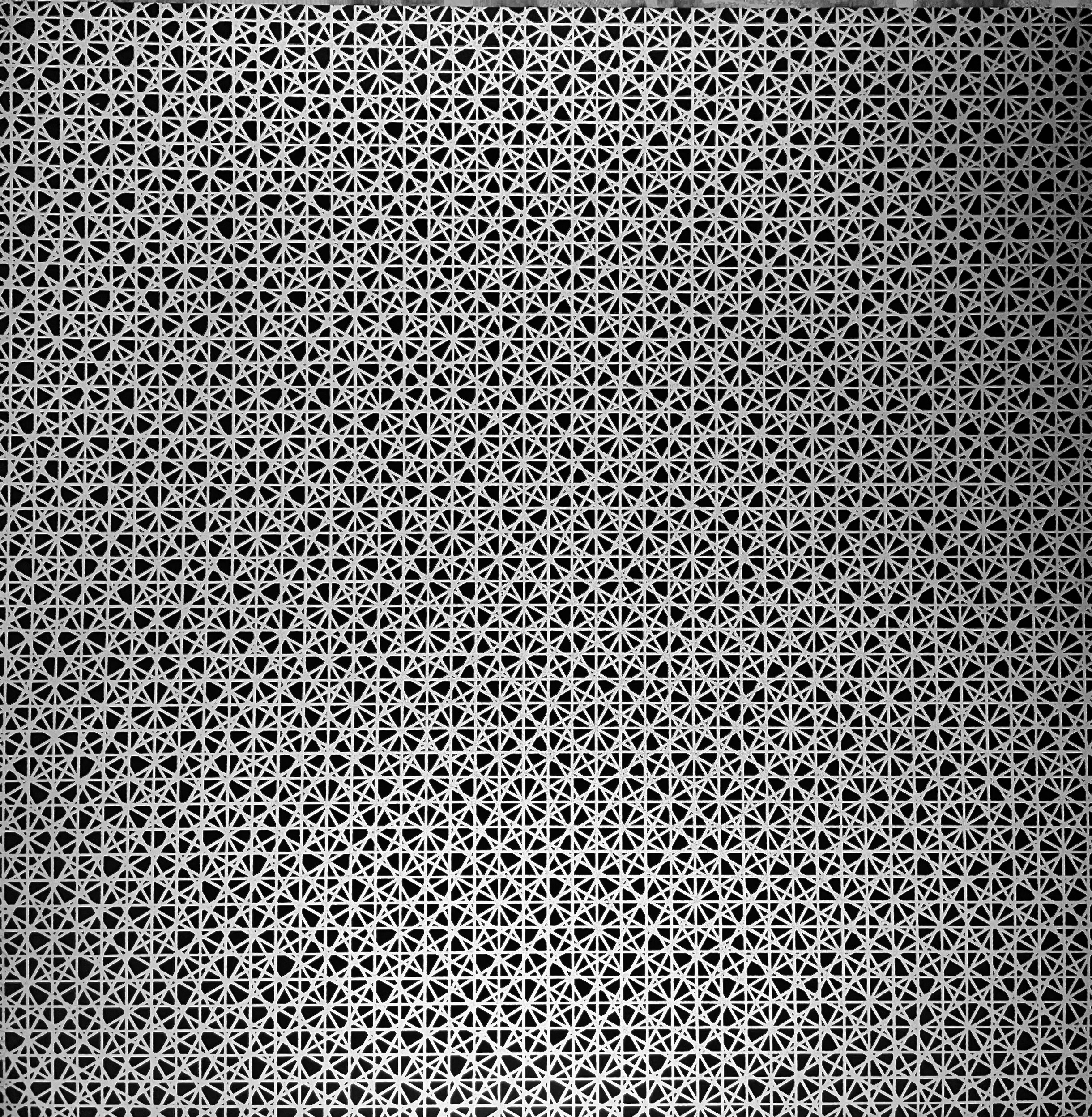
Trame
Francois Morellet
Available
€800
Please select a copy before adding to cart
IQONIQ collaborates with renowned historical galleries in the Italian and international art scene to ensure that every print is meticulously verified and certified. Our dedication to transparency and quality allows us to offer artworks of proven value, enriching our clients’ collections with unique, authentic pieces of verified origin.
For more information on our provenance verification procedure, click here.
Description
Provenance: Il bello dell arte moltiplicata
Dimensions: 69 x 69 cm
Signature: Pencil signature
Product conditions: Mint
Technique: Screen printing
FRANÇOIS MORELLET
Born on April 30, 1926, he is considered the greatest precursor of minimalism in Europe and one of the greatest masters of geometric abstraction. In 1937, the family moved to Paris. Morellet began to paint in the full sense of the term in 1946, but it was in the 1950s that, influenced by the neoplasticism of Mondrian and Van Doesburg, he proceeded towards a radical formal and chromatic reduction in a mix of chance and reason. Morellet understands painting as capable of expressing itself in a simple and geometric language built on simple forms. He, therefore, prefers squares, triangles and lines, and uses a limited range of colours. The turning point was 1951. Thanks to some trips, the first of which to Sao Paulo, Brazil, where he met the artist Max Bill, and then to Spain, where he could admire the Alhambra in Granada – a complex of architectural palaces of Islamic origin which left Morellet fascinated both from the point of view of the architectural structure and the geometric rigour – the painter’s artistic career records the definitive turn towards abstraction and geometrism. Between 1960 and 1970 he therefore produced the so-called “Random Distributions” and the “Repartition alle toires”.
The artist begins to create the first ‘frames’, that is, networks of parallel lines superimposed in a precise order. Furthermore, determined to find a new means of expression, Morellet began to use neon in his works. In 1972 he participated in the Venice Biennale and began to exhibit his retrospectives throughout Europe, until 1980 when he also exhibited in the United States. He created several exhibitions in recent years, at the Kunstmuseum in Bochum and Düsseldorf in 1972, at the National galerie in Berlin and the Musée d’art moderne in Paris five years later. Between 1970 and 1980, he established and trained a new group of artists under the acronym GRAV (Groppe de Ricerche d’Art Visuelle), with the aim of creating an experimental art based on the scientific knowledge of visual perception. A new period begins for him in which the artist seeks a strong interaction with the space that surrounds him. Between the 80s and 90s, he produced several works including “Disfigurements”, “Declinations de pi Greco” and “Geometrees”. He created new exhibitions, at the Albright-Knox Art Gallery in Buffalo, the Musée d’art contemporain in Montreal and The Brooklyn Museum in New York, in 1984, and at the Center Georges Pompidou and the Stedelijk Museum in Amsterdam two years later late. Among his permanent installations, we remember the square of Grenoble, created in 1988, the Musée des Beaux-Arts of Grenoble, of 1991, the Kunstmuseum of Bonn, year 1997, the Geneva Tunnel in the following year and again, the building of the Daimler-Crysler, on the Potsdamer Platz in Berlin, created by Renzo Piano, the intervention in the Obayashi Corporation building in Tokyo and the Bahnhof Ost in Basel in 1999. In the 2000s it was exhibited at the Galerie Nationale du Jeu de Paume in Paris, the Museum Würth in Kunzelsau and the Haus für Konstruktiv in Zurich. One of his last works dates back to 2010, “The Spirit of Stairs” commissioned by the Louvre.
