
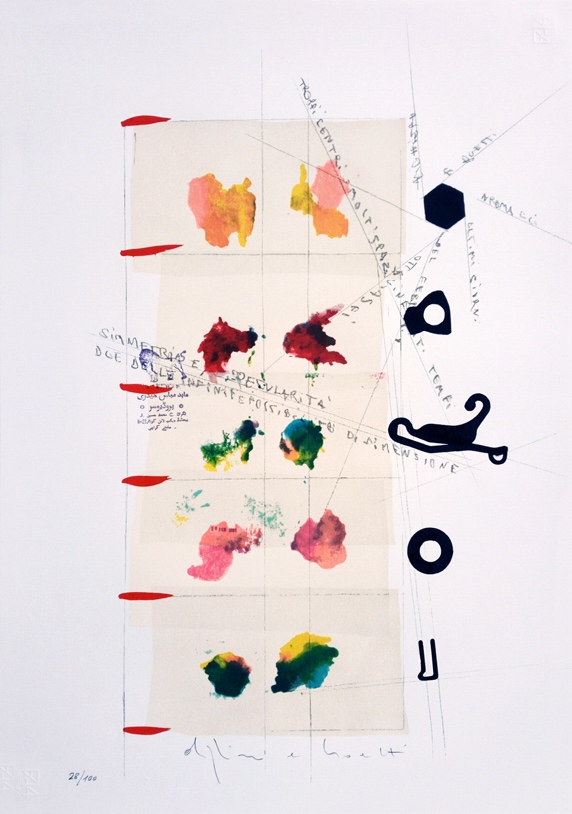
Simmetria e specularità
Boetti
Available
€1.800
+5% VAT
Please select a copy before adding to cart
IQONIQ collaborates with renowned historical galleries in the Italian and international art scene to ensure that every print is meticulously verified and certified. Our dedication to transparency and quality allows us to offer artworks of proven value, enriching our clients’ collections with unique, authentic pieces of verified origin.
For more information on our provenance verification procedure, click here.

Description
Provenance: Stein
Dimensions: 70 x 50 cm
Year: 1985
Signature: Pencil signature
Product conditions: Good
Technique: Color strokes on paper 100+20pa
ALIGHIERO BOETTI
Alighiero Boetti (Turin, 1940 – Rome, 1994) was one of the main protagonists of the Arte Povera group and one of the most appreciated Italian artists of the second half of the twentieth century. He began taking his first steps in art in the 1960s, very young, after leaving university studies and deciding to follow his passions. He soon joined the Arte Povera movement and then managed to gain important international recognition at the height of the collective’s success. Boetti was a very prolific conceptual artist, who used different techniques to create his works, some even very manual such as embroidery or collage. He also created multiple versions of the same subject, producing them in rather large numbers. A clear example of this is the works linked to postal services, which were reproduced over and over again by the artist to reflect precisely on the concept of continuous mechanical creation.
The conceptuality underlying Boetti’s works seems not to follow a particular trend, but to arise from ideological ideas of various types ranging from the reuse of unconventional materials to geopolitics, from the concept of duplication to self-reflection, from Arab culture to geometry. Very important for Boetti’s biography and artistic development was a trip to Afghanistan, a country where the artist returned periodically for a long time until the political events that led to the occupation of the country at the end of the Seventies prevented him from returning. Numerous exhibitions have been dedicated to him, both in life and post-mortem, in major museums around the world, and a very large group of his works is part of the permanent collection of the MoMA Museum of Modern Art in New York.
