
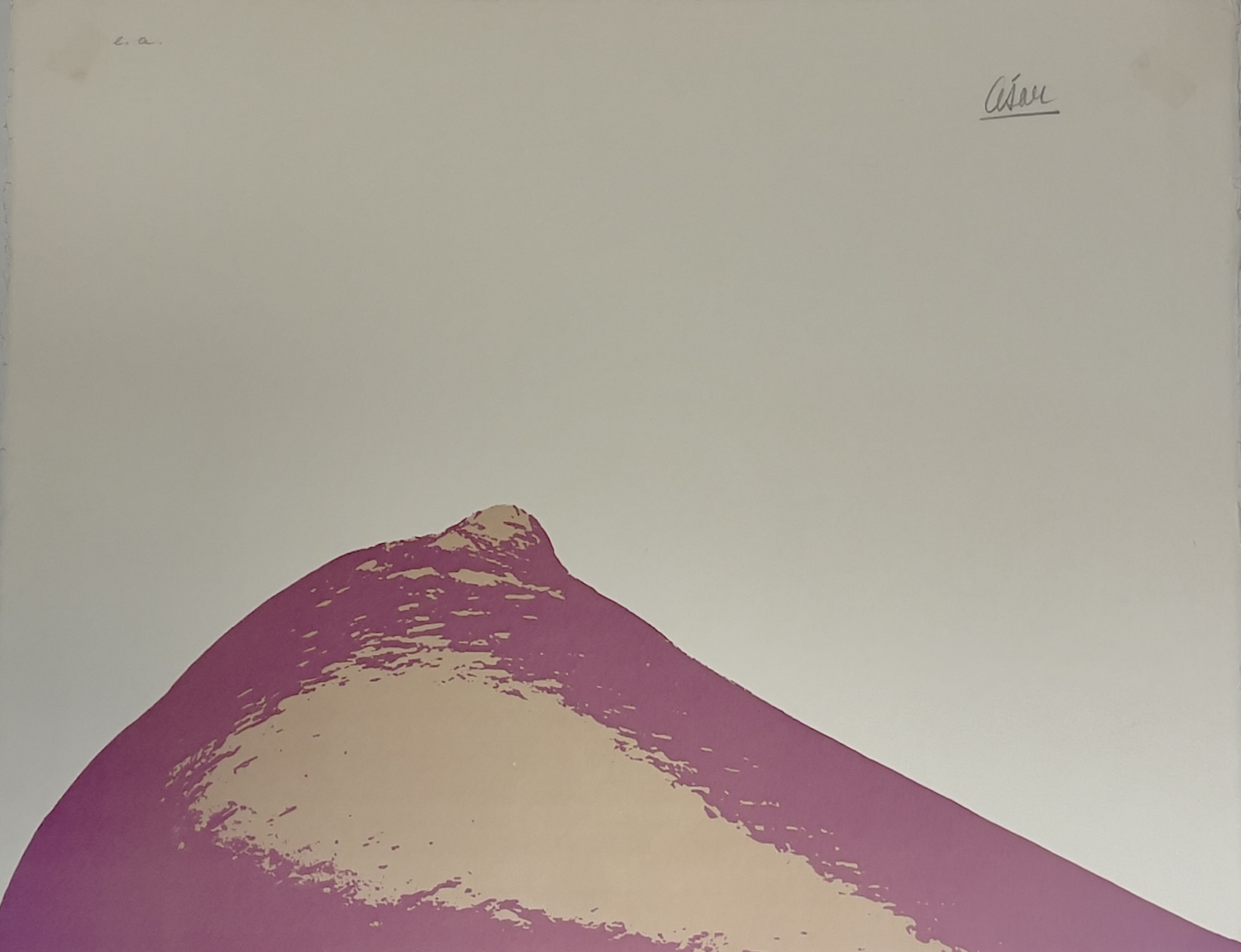
Seno
César Baldaccini
Available
€800
Please select a copy before adding to cart
IQONIQ collaborates with renowned historical galleries in the Italian and international art scene to ensure that every print is meticulously verified and certified. Our dedication to transparency and quality allows us to offer artworks of proven value, enriching our clients’ collections with unique, authentic pieces of verified origin.
For more information on our provenance verification procedure, click here.
Description
Provenance: Alfredo Ceruti
Dimensions: 57 x 45 cm
Signature: Pencil signature
Product conditions: Mint
Technique: Silkscreen printing
CÉSAR BALDACCINI
Born in Marseille on January 1, 1921 to Italian parents. Studied at the École des Beaux-Arts in Marseille from 1935 to 1939 and later at the École des Beaux-Arts in Paris. He settled permanently in Paris in 1943, moving above Alberto Giacometti’s studio, where he met Jean Cocteau, Pablo Picasso, and Jean Paul Sartre. In 1952 he began making sculptures by welding together scrap iron, becoming known for his massive sculptures representing insects, various types of animals, nudes, etc. His first major solo exhibition was held in Paris, at the Salon de Mai, in 1955. It was so successful that all the works in the exhibition sold out in a short time, and the artist was invited to participate in the 1957 Venice Biennale. In 1960 he created the first “compression,” achieved by precisely compressing scrap cars until they became compact packages. In the same year César joined the Nouveaux Réalistes group, which included Arman, Yves Klein, Martial Raysse, Jean Tinguely, Pierre Restany and others.
In 1965 he began working with plastic, first with plastic molds of human footprints and from 1966 onward pouring expanded polyurethane, which he allowed time to expand and solidify. As early as 1966 César renounced welded metal sculpture and began working with expandable plastics. From 1967 to 1970 he organized a series of events in which he produced expansions in the presence of the public. His later works also include sculptures in fused crystal. In 1982 retrospectives of his works are organized by the Musée d’Art Moderne in Liège, the Espace Niçois d’Art et de Culture in Nice, the Seibu Foundation, and the Ottara Museum in Japan. In 1995 he participated in the Venice Biennale. César died in Paris on December 6, 1998.
