
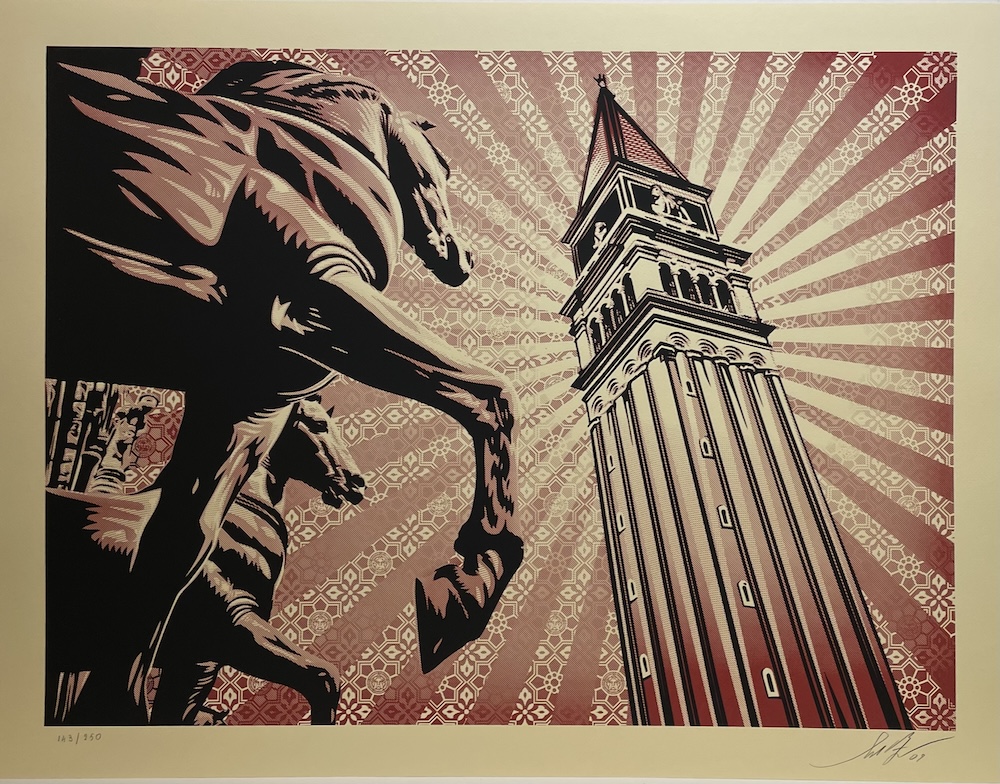
Piazza San Marco
Shepard Fairey (Obey)
Available
€1.600
+5% VAT
Please select a copy before adding to cart
IQONIQ collaborates with renowned historical galleries in the Italian and international art scene to ensure that every print is meticulously verified and certified. Our dedication to transparency and quality allows us to offer artworks of proven value, enriching our clients’ collections with unique, authentic pieces of verified origin.
For more information on our provenance verification procedure, click here.
Description
Provenance: Spirale Milano
Dimensions: 70 x 90 cm
Signature: Pencil signature
Product conditions: Mint
SHEPARD FAIREY (Obey)
Shepard Fairey, considered one of the most well-known and influential contemporary street artists is originally from South Carolina and graduated from the Art Academy in 1988. In 1989, while explaining to a friend how to create a stencil, he asked him to make one with an image he had just seen in the newspaper. The friend refuses because he thinks the idea is stupid, but finding it amusing Shepard nevertheless decides to create the stencil with Andre The Giant’s face: thus was bor that symbol that will make Shepard Fairey known to the world under the pseudonym OBEY His fame peaked in 2008 when he created the HOPE poster with Barack Obama’s face for the U.S. presidential election (later purchased by the U.S., National Portrait Gallery). Artist, activist, graphic designer and illustrator Fairey 2001 has also been the founder of the OBEY clothing brand, which finds fertile ground in the skate scene and is for him another expressive medium on which to continue his poetics and political instances and which further consecrates him to the general public and coming out of the niche of street art.
His clothes, take up and iconicize the elements of his art. In fact, the very name of the brand comes from a campaign Fairey produced in 89, “AndrĂ© the Giant Has a Posse,” stickering propaganda that later evolved into “Obey Giant,” which grew out of an international network of collaborators who replicated Farey’s original designs and helped make his images viral. The stickers according to the artist, “do not have a specific meaning but exist to cause people to react.” Acts of vandalism or artistic expression, divide critics but make their way into underground culture, of clear DIY and post-punk inspiration, which uses them as a tool to make its voice heard, and often its dissent against mainstream culture, from which, however, it draws stylistic and rhetorical cues as precise as the advertising slogan and the compulsion to repeat. His work, openly inspired by phenomenology in a Heiddegerian key, is explained in the 1990 manifesto.
