
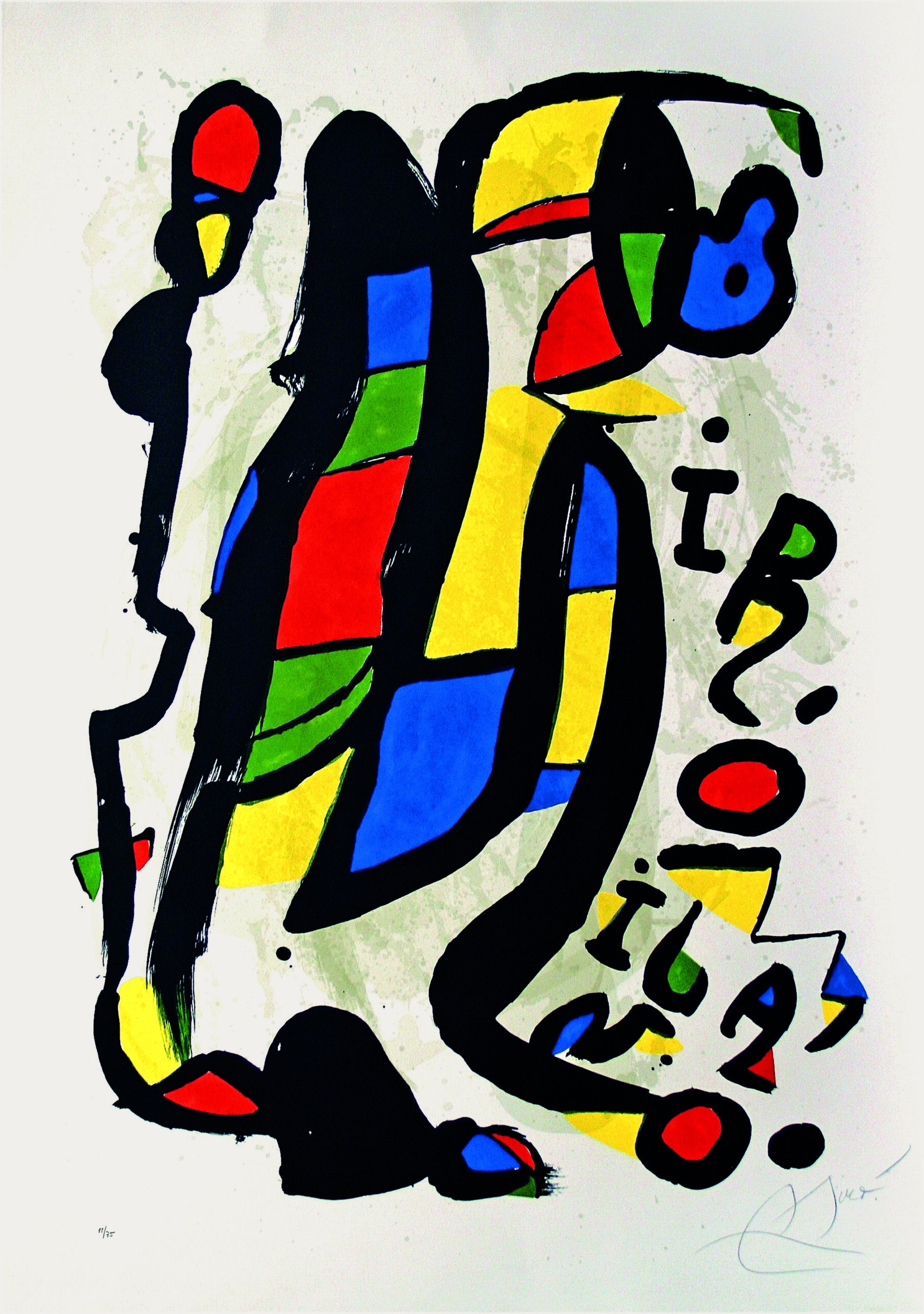
Miró Milano, 1981
Joan Miró
Available
€9.500
Please select a copy before adding to cart
IQONIQ collaborates with renowned historical galleries in the Italian and international art scene to ensure that every print is meticulously verified and certified. Our dedication to transparency and quality allows us to offer artworks of proven value, enriching our clients’ collections with unique, authentic pieces of verified origin.
For more information on our provenance verification procedure, click here.
Description
Provenance: Gio Marconi
Dimensions: 98,5 x 69 cm
Signature: Pencil signature
Product conditions: Mint
Technique: Lithograph – 75 copies + XXV
JOAN MIRÓ
He was born in Barcelona, Spain, on April 20, 1893. His father was a watchmaker and his mother is the daughter of a cabinetmaker originally from Mallorca. His artistic predisposition was manifested from the time he was still a child, thanks in part to the influence of his family. He held his first solo exhibition in 1918 at the Galeries Dalmau. In 1920 he moved to Paris, where he joined the artistic circle of Mont Martre painters to which Pablo Picasso and the Dadaist Tristan Tzara belonged. In 1923, with the painting “Plowed Land” in Montroig, he began his definitive approach to Surrealism. Through Pablo Picasso and Pierre Reverdy he comes into contact with the Surrealist movement and in particular with Masson. During this period Miró lives between Paris and the farm of Montroig, and, at the suggestion of the father of surrealism Breton, gives life to a painting devoid of perspective effect with forms in full freedom. He also begins to introduce titles in the paintings as in the famous painting “Nude” of 1926. Also in the same year he worked with Max Ernst on the sets and costumes for his “Romeo and Juliet.”
In 1928 his ever-evolving artistic research led him to want to reinterpret the works of the great painters of the 16th century using the forms of advertising as well. He simultaneously produced works of deconstruction using collages. In 1927 he made his first poem painting that features direct inscription on the canvas of phrases of a poetic nature. During this period he used to spend winters in Paris and summers on the Montroig farm. During his Surrealist period (1924-1930) he became convinced of the social role of art and its ability to reach the masses; that is why by exploiting his wit and a keen sense of humor he painted by affixing his poetic inscriptions to the canvas. From this period is the famous painting, “Harlequin’s Carnival.” In 1929 he married Pilar Juncosa in Palma de Mallorca: the two had a daughter, Maria Dolores. In the same years he continued his experimentation by producing lithographic works, etchings and sculptures. The civil war that had just broken out in Spain affects him deeply, so he tries to help his compatriots by raising funds to support the republic. In 1937 he also painted a large mural to draw attention to Spain in the Spanish pavilion at the International Exhibition in Paris. In 1954 he won the prize for graphic art at the Venice Biennale and in 1958 the Guggenheim International Prize. In the early 1960s he was greatly influenced by American painting, which led him toward an increasingly insistent abstractionism and a true domination of pure color. In 1972 he created the Joan Miró Foundation in Barcelona, devoting himself simultaneously to set design and sculpture. In the last period of his life he also devoted much time to ceramics, creating two works for theUnesco building in Paris: the Wall of the Moon and the Wall of the Sun. As he grew older, his artistic ideas became even more radical; he even devoted himself to real experiments in gas sculpture and four-dimensional painting. Joan Miró died in Palma de Mallorca on December 25, 1983, at the age of ninety.
