
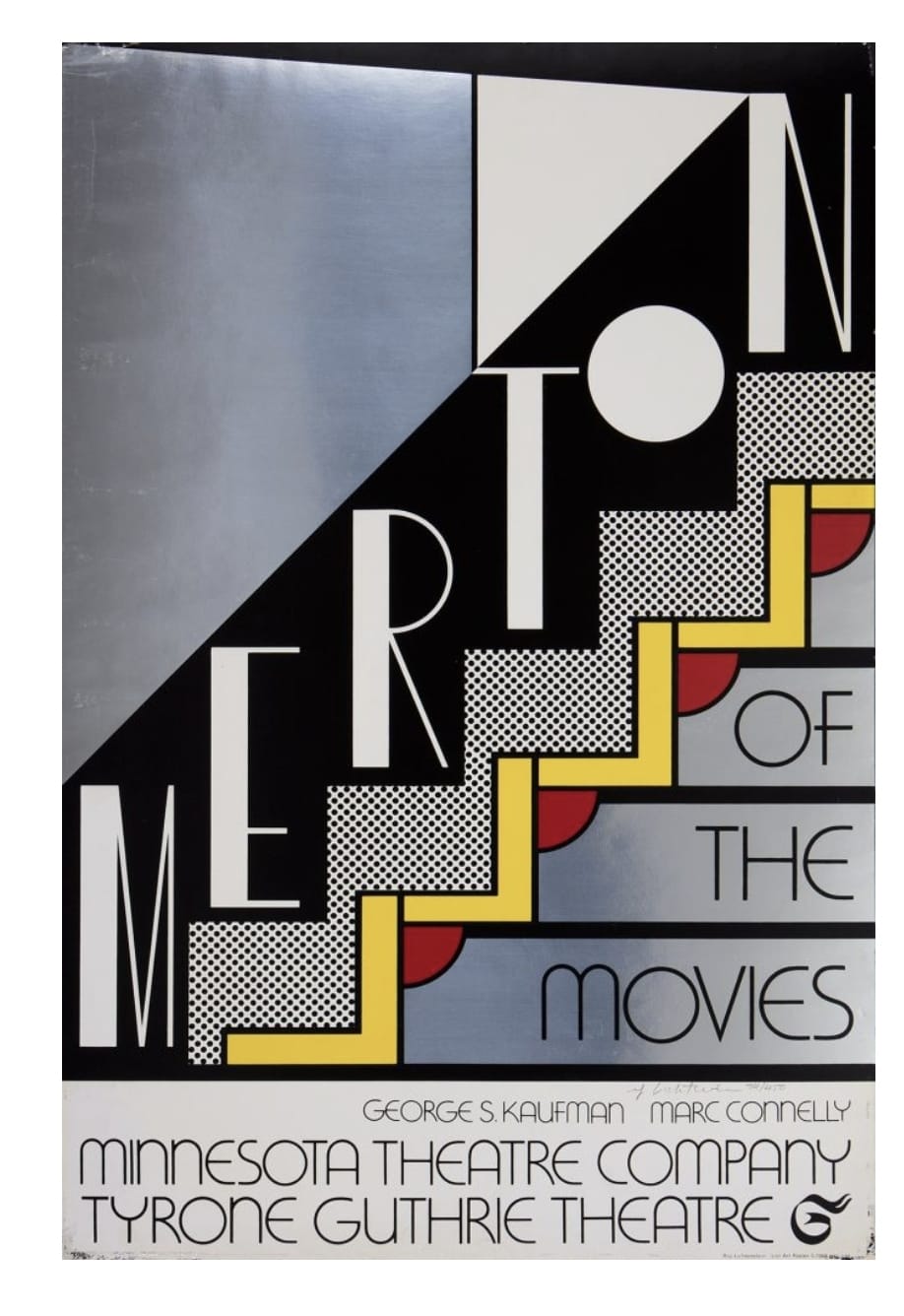
Merton of the movies poster
Roy Lichtenstein
Available
€4.500
Please select a copy before adding to cart
IQONIQ collaborates with renowned historical galleries in the Italian and international art scene to ensure that every print is meticulously verified and certified. Our dedication to transparency and quality allows us to offer artworks of proven value, enriching our clients’ collections with unique, authentic pieces of verified origin.
For more information on our provenance verification procedure, click here.

Description
Provenance: Il bello dell arte moltiplicata
Dimensions: 76 x 51 cm
Signature: Pencil signature
Product conditions: Mint
Technique: Color screen printing on silver foil
ROY LICHTENSTEIN
Was born in New York in 1927. He is one of the most representative exponents of Pop Art, as well as one of the most famous artists of the second half of the twentieth century. He approached art as a teenager. Fundamental stages of his education are the Art Students League of New York and the Ohio State University in Columbus which he attended simultaneously. He interrupted his studies in 1943 when he was sent to Europe due to the Second World War. He returned to Ohio in 1946 where he continued his studies and graduated; he specialized in Fine Arts in 1949. 1951 was the year of his first solo exhibition: he exhibited in New York, in the Carlebach Gallery, where he presented both painted works and assemblages of various objects and materials. In 1956 his works began to approach Pop Art and Abstract Expressionism.
The characters most loved by the public begin to appear in his works, such as Mickey Mouse and Bugs Bunny. His art is close to the popular world and in particular to comics. His technique involves superimposing a metal mesh on the canvas, thus alluding to the dotted language of comics. His innovation is to convey a current and important message in a simple, symbolic way. Lichtenstein leads us to focus on cartoons that we usually read in passing. Over the years he was called to participate in various exhibitions, including the 1964 Universal Exhibition for which he was commissioned to create a mural for the New York Pavilion. Between the ’70s and ’80s, he dedicated himself to the creation of Nature Morte and approached Futurism, Russian Constructivism, Surrealism and German Expressionism. Lichtenstein goes down in history as the artist who managed to bring pictorial art closer to the commercial world and comics. He died in 1997 in New York due to worsening pneumonia.
