
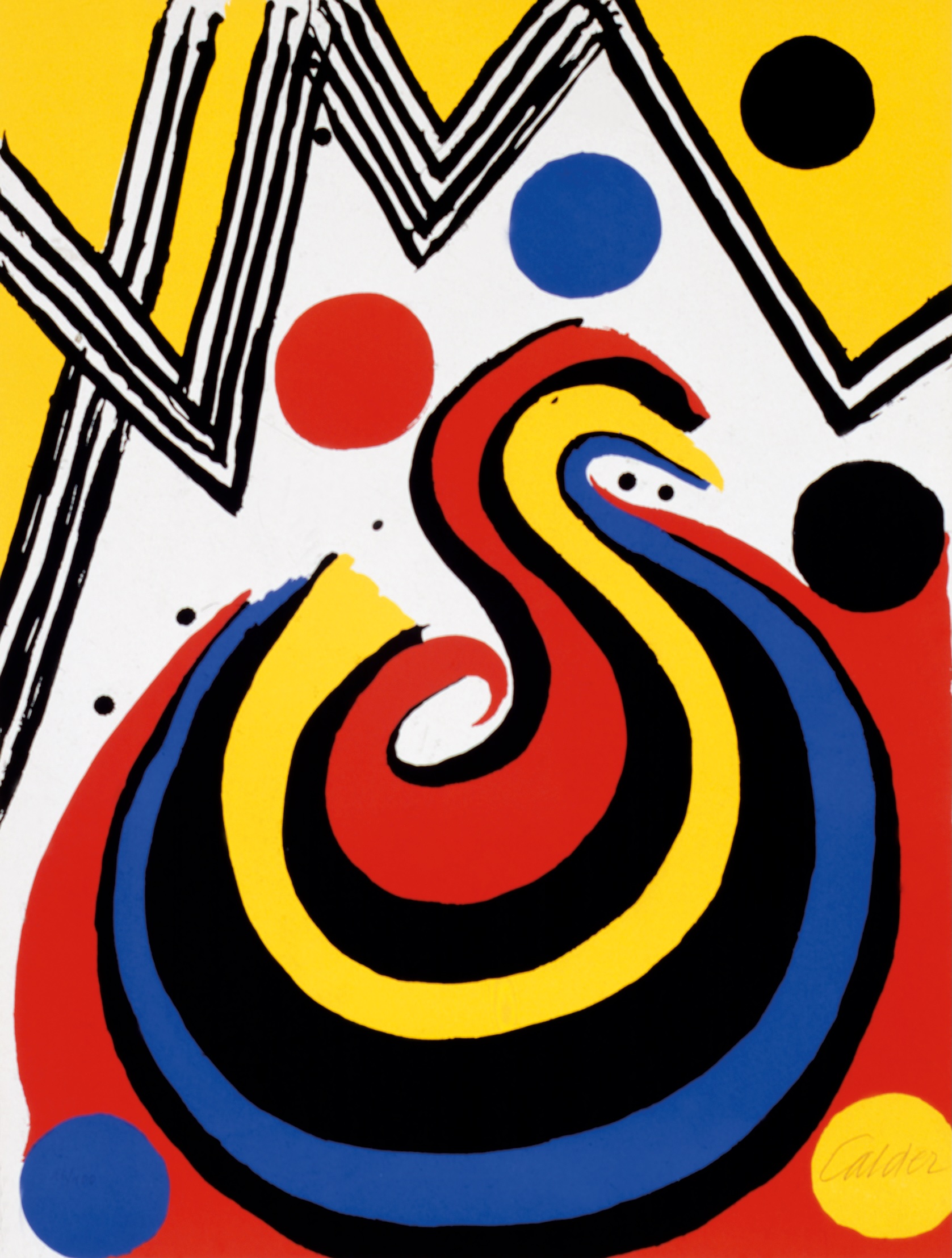
Girandola, 1972
Alexander Calder
Available
€5.000
Please select a copy before adding to cart
IQONIQ collaborates with renowned historical galleries in the Italian and international art scene to ensure that every print is meticulously verified and certified. Our dedication to transparency and quality allows us to offer artworks of proven value, enriching our clients’ collections with unique, authentic pieces of verified origin.
For more information on our provenance verification procedure, click here.

Description
Provenance: Gio Marconi
Dimensions: 75,5 x 56 cm
Signature: Pencil signature
Product conditions: Mint
Technique: Lithograph – 100 copies
ALEXANDER CALDER
(1898-1976) Born into a family of artists: his father was a sculptor and his mother a painter; he was immediately encouraged to pursue his passion for art and already as a child he showed an evident talent in handling materials. Nonetheless, he does not pursue an artistic career and decides to graduate in engineering. In one of the many jobs he carried out after obtaining his degree, finding himself on a ship sleeping on the deck, he saw the scene that made him lean towards a different life choice and which he would continue to recall throughout his existence: a splendid dawn and a bright full moon. Shortly after this event, in 1923, Alexander Calder moved to New York and began attending the Art Students League and at the same time the “National Police Gazette” hired him as a designer.
Precisely on behalf of this in 1925 he followed some circuses and designed their performances, developing an interest in the world of circus that would accompany him throughout his life. The sculptor Alexander Calder realizes that iron is the material for him, so he begins to use it to portray prominent figures of his time. In 1928 hisfame as a sculptor and inventor was now widespread and his first solo exhibitions also arrived; he also met very famous artists and intellectuals and a visit to the studio of his friend Piet Mondrian led him to a brief phase as an abstract painter, which soon ended with a return to his beloved sculpture. In 1931 came the real turning point in his artistic career by Calder, because he created his first kinetic sculpture, which kicked off a completely new artistic genre. Later he throws himself into large-scale sculptures, a prelude to the subsequent large-scale work for public works. The shortage of materials caused by the Second World War led him increasingly to work with wood, giving rise to the series of sculptures called constellations, in which the elements carved into the wood were then anchored with wire. His career was, until the end, full of successes and great collaborations. Alexander Calder died of a heart attack in 1976.
