
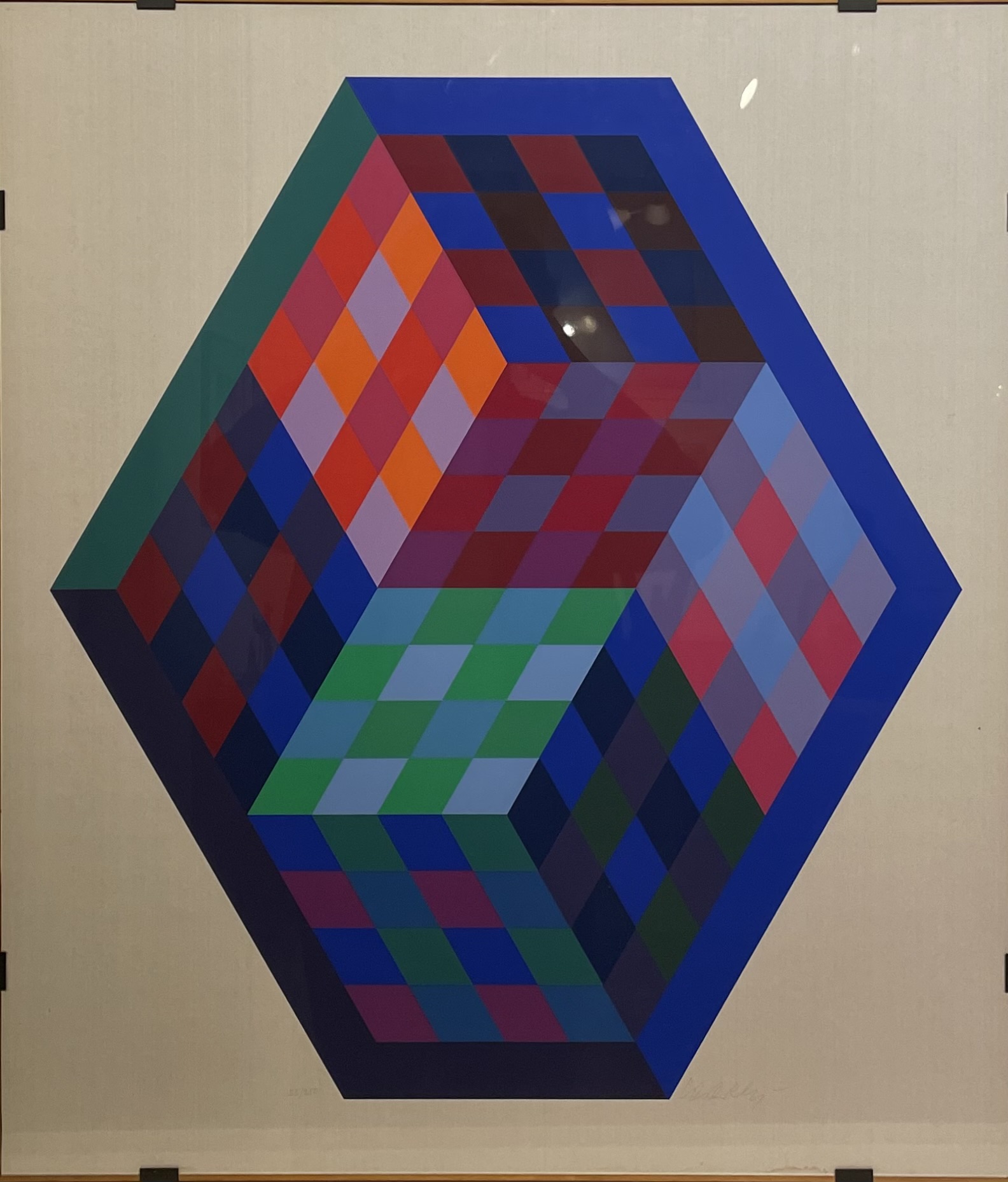
Geometria
Victor Vasarely
Out of stock
€1.500
+5% VAT
Please select a copy before adding to cart
IQONIQ collaborates with renowned historical galleries in the Italian and international art scene to ensure that every print is meticulously verified and certified. Our dedication to transparency and quality allows us to offer artworks of proven value, enriching our clients’ collections with unique, authentic pieces of verified origin.
For more information on our provenance verification procedure, click here.
Description
Provenance: Spirale Milano
Dimensions: 72 x 62 cm
Signature: Pencil signature
Product conditions: Mint
Technique: Silkscreen on paper
VICTOR VASARELY
Victor Vasarely (Pécs, 9 April 1906 – Paris, 15 March 1997) was a Hungarian-born French painter and graphic designer. He was the founder of the Op art artistic movement, which developed in the ’60s and ’70s and, together with Bridget Riley, the main exponent. In 1927, after studying medicine for a couple of years at the University of Budapest, he decided to dedicate himself to art and in 1929 he enrolled at Mühely, a school founded by Alexandre Bortnyik which followed the principles of the Bauhaus of Dessau. In this period he became acquainted with Constructivism and abstract art. After leaving Hungary, in 1930 he settled in Paris, where he began working as a graphic designer. In the initial graphic period (1929-1946), the artist laid the foundations of his aesthetic research, exploring themes that he would take up again later. Between 1935 and 1947, he rediscovered painting and, particularly influenced by Cubism and Surrealism, concentrated on portraiture, still life and landscape.
The works of the so-called “Belle-Isle” period (1947-1958) were born from a stay on Belle-Isle, which marked the transition to abstraction through the use of natural materials. From the “Denfert” period (1951-1958) are the curious drawings inspired by the walls of the Denfert-Rochereau metro station in Paris. This was followed by the “Cristal-Gordes” period (1948-1958), with works in which forms of contrasting colours were juxtaposed, and the “Black and White” period (1950-1965), in which the artist resumed his initial graphic research. In 1955 he exhibited with other representatives of kinetic art at the Denise René Gallery in Paris and in the same year he published his Manifeste Jaune. In 1965 he participated in the “Responsive Eye” exhibition held at the Museum of Modern Art in New York and dedicated entirely to Optical Art. Continuing his studies on movement and perception, Vasarely returned to drawing in the so-called “Vonal” period (1964-1970 ), where he took up linear and graphic themes from the “Black and White” period, but added colour. The “Vega” period began in 1968 when the deformation of the elements of the composition created the optical effect of swelling of the surface of the painting. In 1976 he created the Vasarely Foundation in Aix-en-Provence, thus concretizing the idea that art should not be disconnected from the social context and the environment that surrounds it.
