
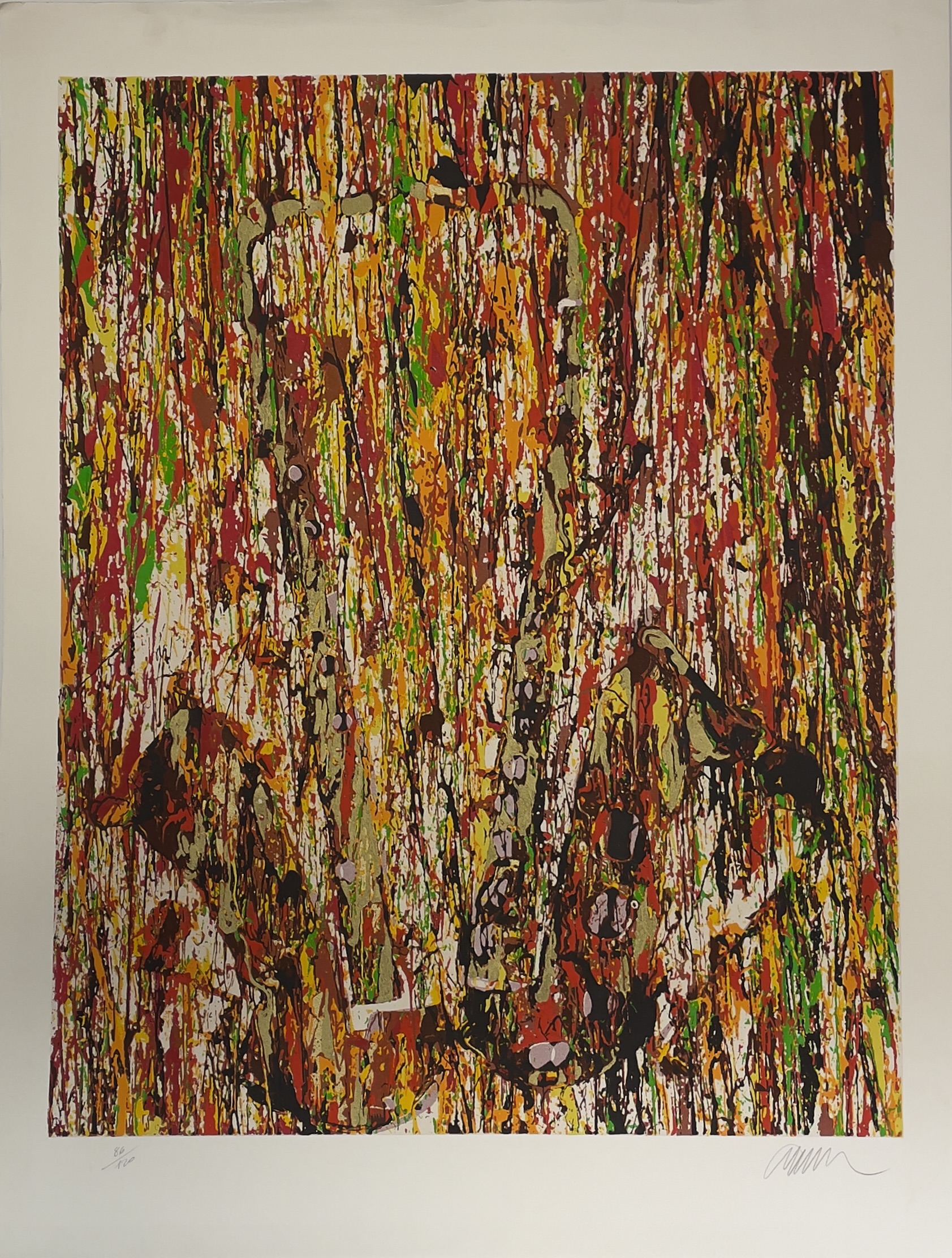
Colori due sassofoni
Arman Pierre Fernandez
Available
€800
+5% VAT
Please select a copy before adding to cart
IQONIQ collaborates with renowned historical galleries in the Italian and international art scene to ensure that every print is meticulously verified and certified. Our dedication to transparency and quality allows us to offer artworks of proven value, enriching our clients’ collections with unique, authentic pieces of verified origin.
For more information on our provenance verification procedure, click here.
Description
Provenance: Alfredo Ceruti
Dimensions: 78 x 104 cm
Signature: Pencil signature
Product conditions: Mint
Technique: Silkscreen printing
ARMAND PIERRE FERNANDEZ
He was born in Nice on November 17, 1928. He majored in philosophy and mathematics, enrolled at the École National des Arts Décoratif in Nice in 1946, and in 1949 moved to Paris to study archaeology and oriental art at the École du Louvre. Returning to Nice in 1953, he began working abstractly and collaborated with Yves Klein. The following year he was impressed by the works of Kurt Schwitters on display in Paris and, making use of office stamps, produced his first Cachets, exhibited in 1956 at his first solo show at the Galerie du Haut-Pavé in Paris. In 1958 a typo on the cover of a catalog convinced him to omit the final “d” of his name. From the same year are the Allures d’objets, imprints on paper of objects bathed in oil paint, followed in 1959 by his first sculptures: the Accumulations, accumulations of identical everyday objects, and the Poubelles, miscellaneous scraps placed in a transparent container. In 1960 he signed the manifesto of Nouveau Réalisme, subsequently participating in the group’s various events.
The following year he went to New York for the first time, where he held a solo show at the Cordier-Warren Gallery and participated in the exhibition “The Art of Assemblage” at the Museum of Modern Art. In the 1960s he continued his artistic research by making Coupes, cut or sawn objects; Colères, broken or damaged objects; Combustions, objects subjected to burning; and Inclusions, accumulations of objects immersed in transparent polyester resin. He has since exhibited at the Stedelijk Museum in Amsterdam in 1964 and at the Venice Biennale in 1968. In the 1970s he made accumulations using concrete or pieces of cars supplied by the car manufacturer Renault. In the two decades that followed he worked with different techniques and materials, producing major public commissions such as the bronze monument A la République (1984), at the Palais de l’Elysée in Paris, or the monumental Espoir de Paix (1995) in Beirut, an accumulation of tanks and concrete. In the late 1990s Arman radicalized his artistic research and in parallel made large-format etchings and drawings, also collaborating with poets and writers. Numerous exhibitions were devoted to his work until his death, which occurred in New York on October 22, 2005.
